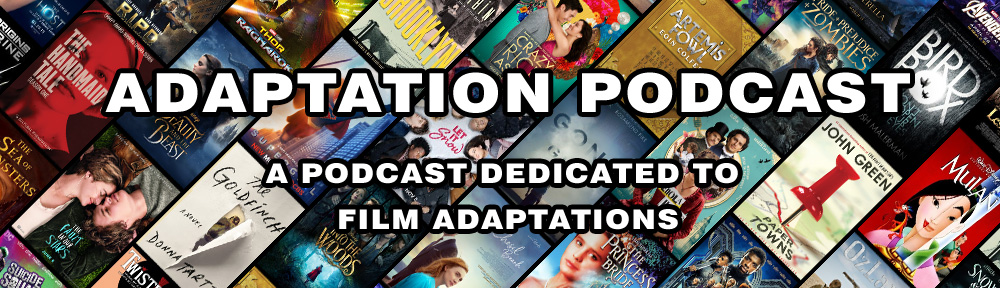
If you’re anything like me coming off of Oscar season, you have a long list of films that are now on your To Watch list (okay, you had that list on the journey up to the Oscars, but it’s ever more important now that the films have actually won something). I know it’s tempting to prioritize that list by which films won the most awards (those are surely the best ones, right?), but if you were to ask my opinion, Still Alice belongs at the top.
 Sure, it’s not flashy like the other winners. Birdman looks like it’s filmed all in one shot. The Grand Budapest Hotel has that traditional Wes Anderson look. The Theory of Everything is the story of someone with a household name.
And Still Alice is about a fictional women with early onset Alzheimer’s disease. This is not a feel good movie. In fact, I started crying about ten minutes in and didn’t stop until the end. But it’s simple and insightful and full of performances that make the characters as real as anyone. That’s the point. Alice might not be real, but her story shows us the struggle of the 5 million people in the United States diagnosed with Alzheimer’s.
It’s no coincidence that the only awards Still Alice was nominated for were for Julianne Moore as Best Actress or that she won every time, not just at the Oscars, but the Golden Globes, the BAFTAs, the SAG Awards, and the Critic’s Choice Awards. The film is told from Alice’s perspective, which is why Moore’s role is so important (though I would argue that Glatzer and Westmoreland’s direction is worth some awards as well). She is the movie, it all hangs on her character, on her performance, and dear god does she deliver. The character goes through so many emotions in such rapid succession, each with its own layers of what she is actually feeling and what she wants her family to see. Amazingly, Julianne Moore pulls all this complexity off beautifully.
The story itself has a fairly simple concept that packs a big punch. Alice is a linguistics professor at Columbia University whose career, life and self-worth is partially tied to her intelligence. Education is a priority with her and her doctor husband, something they have managed to pass on to two of their three children. So when Alice’s memory starts to slip, she feels like her identity is being taken from her. In a semi-ironic twist, the person who most understands her isolation is her wayward, non-collegiate daughter played by Kristen Stewart in an equally moving performance.
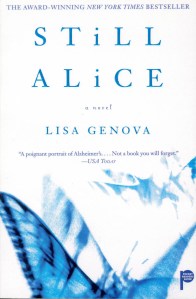 Still Alice is based on the novel by Lisa Genova, who has a degree biopsychology and a PhD in neuroscience. Still Alice was her first novel, but since then she has tackled other types of cognitive impairments in Left Neglected, Love Anthony and her upcoming novel Inside the O’Briens.
I have not read the book myself and I’m not sure that I’m planning to (if I cried that much in the movie, I might die of dehydration reading the book), but the film did make me want to check out Genova’s other novels. From what I can tell, they are each written from the perspective of the impaired person, giving voice and insight to people suffering with not being able to express themselves.
That’s what I took away from the film – the frustration, anger and embarrassment that comes from not being able to say what Alice wants to say, from simple everyday thoughts to what she’s going through overall. Such insight and understanding should surely be enough to move this to the top of your list of films to see.
 If you couldn’t tell by the length of the episode, Dorin and Kendyl have a lot to say about Kingsman: The Secret Service and the original comics by Mark Millar and Dave Gibbons. They discuss the improved themes, the interesting characters and, of course, the annoying sexism.
 Our hosts are back, discussing the second book in the Divergent trilogy, Insurgent. There is a lot to go over in this book: visiting the different factions, Tris’s PTSD, the motivations of the untrustworthy and how this book stacks up against the last. Listen and tell us what you think about all these things and more!
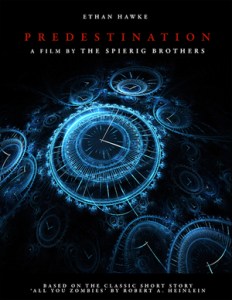 Recently, a commenter turned us onto the film Predestination (2014) and the short story it is based on, “All You Zombies”, written by Robert A. Heinlein in 1958, so I checked them out.
 Ethan Hawke’s character is a time agent who has just recovered from a serious injury while after his foe The Fizzle Bomber. He jumps back in time and strikes up a conversation with a man, who writes confessionals under the pen name “The Unmarried Mother”. Because of that strange pen name, we then get a bet for a bottle of booze and this man’s life story, which begins “when I was a little girl…”. Sarah Snook played this character, Jane when a girl – John as a man.
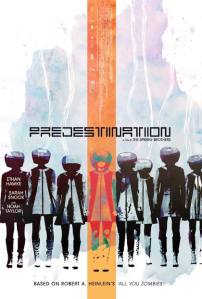 Then Ethan Hawke goes to the hospital to snatch the child and drop it off at the orphanage, the same date and place where Jane was left. This means that the baby that this one person had by himself, the baby is also the same character. All Jane/John. Ethan Hawke recruits John to his time agency and says, “now that you know who she is, you now know who you are, and if you think about it you will know who the baby is and who I am.” Or something of the like, which would make you think that Ethan Hawke is the child, but if that is that case, he is also Jane/John.
 Jess and Kendyl discuss Little Women by Louisa May Alcott, remembering how they felt reading it in younger years and how their opinions have changed.
 This week our hosts have read The Last Apprentice: Revenge of the Witch by Joseph Delaney (or The Wardstone Chronicles: The Spook’s Apprentice for the UK, still by Joseph Delaney). They are pretty amused by the main character’s inability to do as he’s told and considerably less amused by the Spook’s generalizations about women. But over all, they are ready to continue on with this series and to see how the filmmakers will interpret it in the upcoming Seventh Son.
 As fairytale connoisseurs, the team has been looking forward to the film Into the Woods for a long while. Most are extremely pleased, but someone has some issues with the plot.
 Adaptation Podcast