Vlog: Nine Best Adapted Scripts

In which we set a record for list length and tell you about the nine screen adaptations that had awesome scripts.

iTunesTwitterFacebookTumblrYouTube

Related Podcasts:

#22: Because… High School (The Perks of Being a Wallflower)

#30: Do Bananas Float? (Life of Pi)

#34: The Merry Old Land of Manipulation (The Wizard of Oz)


Vlog: BONUS Worst Adapted Character (Ginny Weasley is Awesome, Just Not in the Films)

In which we freak out a little and apologize for a grievous error.

iTunesTwitterFacebookTumblrYouTube

Coriolanus: A Modern Man

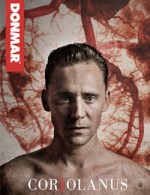
elle-reviews-coriolanus_GBI never really considered productions of plays being adaptations of the original written play. Unless it is play to screen – like Joss Whedon’s film and modern adaptation of Shakespeare’s Much Ado About Nothing, it seemed that productions were just productions of the written play, but when I saw the live stream of the London Theater production of Coriolanus, in my local movie theater, it changed my perception.

The play is formally named, The Tragedy of Coriolanus and is one of Shakespeare’s lesser-known plays and is part of his Historical play set. The story is of a man named Caius Martius, who is a patrician, or aristocratic soldier who has little compassion for the lower classes. He is heralded as a hero after nearly single-handedly defeating the attack of the Volcians, led by his rival Tullus Aufidius at the neighboring Italian city of Corioles and is given the name Coriolanus. However, a famine had rampaged Ancient Rome and the people are in a rage against the upper class. To have their voices heard they have tribunes (representatives) to stand up for them. Coriolanus is given a hero’s welcome, and the Senate offers to make him consul.

In order to gain this office, however, he must go out and plead for the votes of the plebeians (common people), a task that he undertakes reluctantly. At first, the common people agree to give him their votes, but they later reverse their decision at the prodding of two clever tribunes, Brutus and Sicinius, who consider Coriolanus an enemy of the people. This drives the proud Coriolanus into a fury, and he speaks out intemperately against the very idea of popular rule; Brutus and Sicinius, seizing on his words, declare him a traitor to the Roman state and drive him into exile, where his rival surprisingly takes him in and together they plan a bitter attack on the city that betrayed him. For those who have not read or seen this play, I will not spoil the rest.

It is not like a British theatre group to change Shakespeare’s work, and this followed suit, only possibly taking out extraneous and unnecessary but unnoticeable moments from the play. It was done as it would be read, but with more life.

This production of Coriolanus was directed by Josie Rourke and starred Tom Hiddleston as Caius Martius Coriolanus, Mark Gatiss (Mycroft from BBC’s Sherlock) as Menenious a friend and mentor to Coriolanus, Hadley Fraser as the rival Aufidius, Deborah Findlay as his mother Volumnia, Birgette Hjort Sørensen as his wife Virgilia, and Elliot Levy and Helen Schlesinger as Brutus and Sicinia respectively.

Put up at the Donmar Theater in the West End of London, this Coriolanus was different than what you would expect from a Shakespearean play. The theater itself used to be a banana-ripening warehouse, and was utilized as a minimalist theater border lining a black box theater. They used the back brick wall for all of their scenery, which stayed painted half way up in red. It was painted with a bit of graffiti at the beginning, and had firm metal handles in it, which became multi-purpose throughout the play. It was also used as a projector screen to display words of the people chanting in glowing letters.

The stage itself looked like a small canvas square with a ladder upstage left, which allowed Coriolanus to climb offstage. The only set beyond that is a square painted in red by a child at the beginning, chairs to hold characters actively or inactively (as if they were offstage), and a small black square that is aptly painted later on to put Coriolanus on trial – twice. The little set was used very well, with unique staging because the audience was on three out of four sides, having everything stay the same and yet change so seamlessly between scenes. The red square looked like the ropes of a boxing ring, and with scenes of social unrest, political distress and all out war it was perfect for each and every scene.

This minimalist idea continued onto the characters. The costumes were a mix of period and contemporary clothing. It was all very simple and clean, with only a flick of leather chest armor and a sword. The near empty stage never felt empty as it was filled with the voices and presence of each character.

Tom Hiddelston is a fearless actor who took this role full on with the ablity to move seamlessly between all parts of the role and emotions. He portrayed Coriolanus as a complex human being, going from loving son and husband to arrogant aristocrat, from fearless warrior to sarcastic fool, from cold-hearted to soft-hearted. He didn’t put on a mask and go overboard or put on any airs like I see most Shakespeare done. It was a stripped down performance that showed him as a real man and did not feel like we were just watching an actor play out a scene, although I will say I remarked that he was an amazing actor because he could cry on cue and it was absolutely real.

His performance along with the smaller and less cluttered stage was a recipe for intimacy that was felt throughout. At times it seemed so real that it felt like we were all voyeurs looking in on something private. We are there with him every step of the way, watching him become warring god and then wash the blood away to become a flawed and scarred human again, and besides making the whole theater cry with him, he brought us to laugh as he went from having a fit to comforting his mother, and his sarcastic jests as he had to humble himself in front of the “unworthy common folk”.

I could continue to fan-girl over Tom, who is a fine piece of man as seen in this with a near see-through humble shirt and a nice tight pair of jeans, and his fabulous portrayal, but he was not the only amazing actor there. The entire cast made up a superb ensemble, whom under the director were able to bring to life this unique vision of a story that is still relevant today. They all became their characters and spoke Shakespearean English as plain as it was modern English. Where most Shakespeare plays I have seen have been put on as Shakespeare intended, with over acting, big gestures, and over explaining so that any person anywhere in the Globe could understand what was going on, this was a toned down version; a modern play with Shakespearean words.

It is so difficult to talk about this production without bringing up every single moment in it. It isn’t just Tom Hiddleston, it is the power of voice and intonation and character of all the actors, especially Deborah Findlay, Mark Gatiss (as one might expect from Mycroft… with a little more heart), Hadley Fraser and the two tribunes. The way they spoke was natural and human even if the words seem foreign, with snark and sarcasm and love. It was all easy to understand, even if you could not fathom how any of them could memorize those long speeches. The only thing that was questionable at times was the choice of music they used as they changed scenes. It seemed, at first, to be a weird techno fusion, but as the play went on it turned into more warlike drums and sounds that built tension.

This play was put up with such integrity and vision that it easily got under your skin and into your heart. All the actors spurred so many feels; anger, friendship, rivalry and camaraderie, and so much more. Honestly, I would love to have played Virgilia, Coriolanus’ wife, because not only was she a fun character, but she got to kiss him about 4 times throughout the play. Though I would settle for being his rival, Aufidius, because he got to sword fight him, oh and *spoiler alert* kiss him too.

The only way to do it justice is to see the production; the patrons of the theatre I was in gave it a standing ovation even though the actors were not present to receive the applause. Check National Theatre Live for broadcasts and rebroadcasts in theatres near you. Hopefully, they will realize that this is a production too good to keep under wraps and will produce a DVD version.

Did anyone of you see the broadcast? Tell us in the comments what your favorite part was!
Adaptation #74: The School Boy and the Curse of the Midas Gun

header074Our hosts are a bit overwhelmed this episode as we discuss GP Taylor’s The Midas Box and the film adaptation The Adventurer: The Curse of the Midas Box. While enjoying the magical realism of the book, there was a lot to take in, and while the movie had them laughing (probably unintentionally), it was a little watery.
Let us know what you thought of the book, the film and our discussion in the comments!

iTunesTwitterFacebookTumblrYouTubeDownload This Episode

For similar adaptations, check out our episodes on The Invention of Hugo Cabret, Snow White and the Huntsman, The Last Airbender, Beautiful Creatures and City of Bones.

Continue reading

Vlog: What Are We Reading? (February 2014)

In which we give you some more books to add to your To Be Read list.

iTunesTwitterFacebookTumblrYouTube


Adaptation #73: The Book Thief is Death’s Best Friend

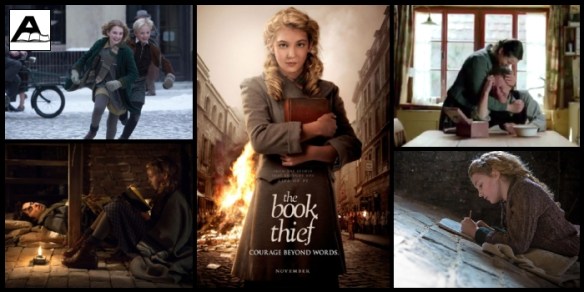
header073FINALLY, all the hosts were able to see Brian Percival’s The Book Thief! They discuss the bits that were perfect, the bits that were upsetting and the bits that other people just didn’t seem to understand in this beautiful and sad story.

Also, we have an episode on the novel by Markus Zusak.

iTunesTwitterFacebookTumblrYouTubeDownload This Episode

For similar adaptations, check out our episodes on Catching Fire, The Hobbit, Les Miserables, Life of Pi, Cloud Atlas, and Anna Karenina.

Continue reading

Vlog: Six Plot Changes That Worked

In which we list plot changes in film adaptations that actually worked with the story.

iTunesTwitterFacebookTumblrYouTube

Related podcast episodes:

#26: Luckily For Hobbits, Size Doesn’t Matter (The Hobbit novel)

#29: Toners For Dwarves (An Unexpected Journey)

#52: Much Ado About Whedon

#72: Never Tickle a Sleeping Dragon (The Desolation of Smaug)

Emma Approved: The Road So Far

When I got to the end of episode 24 of Emma Approved and saw that I had to wait until February for a new video, I didn’t think I’d make it, especially when it ended with an uncharacteristically defeated Emma being comforted by a sweet rather than snarky Knightley. Like a lot of other fans, I filled the void by rewatching the series, multiple times, to pick up on the things that I may have missed the first time around. And now, on this our last Emma-less Thursday, I wanted to get out some thoughts about the series so far.

The Set Up

I have to admit first off, that it took me some time to get into the series and that made me very nervous. The Lizzie Bennet Diaries had me hooked from the first video, but with Emma Approved I was letting the videos stack up for a week or two before I caught up. Happily, I have moved past that phase and am now firmly in the refreshing-my-feed-every-Monday-and-Thursday-for-the-new-video phase. It’s a grand yet torturous place to be.

But the hiatus has given me time to think about why there was such a difference between the two. Emma needs set up. The story itself and the character take time to get into. In The Lizzie Bennet Diaries the set up is just about introducing characters, most of which live under one roof and whose situation in life is familiar to most of us. But Emma’s world is different. The story hinges on the audience really understanding her world, her place in it and her flaws. Emma Approved even took it upon themselves to add additional setup that wasn’t in the original novel in the form of Annie’s hesitations about her marriage to Ryan. It gave us time to see how Emma works, how she schemes and how much she trusts that her own point of view is the only point of view. And it gives us time to fall in love with her despite her intensity so that when she falls, we’re rooting for her to get back up.

The Little Misunderstandings

Before Emma Approved started, we did a podcast on Jane Austen’s novel where we tried to predict what the big mystery was going to be in the series. For The Lizzie Bennet Diaries, we spent most of our time speculating how Lydia’s story would be modernized, but we couldn’t quite put our finger on what the Emma equivalent was. At 24 episodes in, I’m still not convinced that there is that One Big Thing, but I think I’m having just as much fun with the little story tweaks. The note and concert tickets taking the place of Elton’s riddle. The song taking the place of the painting of Harriet (which I find exceedingly more believable than Clueless’s “I have the picture you took in my locker” moment). It’s all the little misunderstandings leading to the big reveals that create the tone for Emma, and Emma Approved is hitting that note perfectly with those cringe-worthy, look through your fingers, second-hand embarrassing moments. I will admit that I had to watch the Emma versus Senator Elton showdown in small intervals while taking deep breaths.

The Status Critique

While I do love where we’re at so far with the series, there are a few things that have been bothering me about how Emma’s world fits together and how that world fits into ours.

In Austen’s novel, Emma and her father hold the highest status position in their town of Highbury, second only to Mr. Knightley. Mr. Elton, however, is a bit lower on the totem pole, to the point where Emma is a bit insulted that he thinks he has a chance with her. In Emma Approved, we are given the impression that Emma runs with a pretty elite crowd, but the status equivalencies of the other characters are a little messy after that, especially in the case of Senator Elton. While his status does make him almost laughably uninterested in Harriet, it also makes him much higher than Emma and Knightley, which is a bit disappointing. I suppose it’s a lesser plot change, but it does change the dynamics between the characters a bit. Even Knightly being more equal with Emma rathat than higher than her is a slight change to their relationship that could have some consequences down the road.

The In-World Disparity

While we’re talking about everyone’s place, the other thing I find a bit confusing is the videos themselves. When the series started, a lot of people were asking how the videos fit into the world of Emma Approved and the creators made this post to explain it. To sum it up, Emma is recording the footage for her future documentary, but the edited videos that we see do not exist in-world. So the characters know that they are being recorded, but the videos are not publicly available as far as they are concerned. This cleared up my original confusion, but also saddened me because I thought that meant that we wouldn’t get any Q&A videos, which were some of my favorite videos in The LBD.

But apparently we can have Q&A videos, as we’ve now seen two of them. But I don’t understand how people are sending in questions for Emma and Knightley to answer in videos that they are not supposed to have seen. Earlier this week, there was an advice blog post written by Knightley and that seemed to make a bit more sense. Of course Emma would run a blog for her company. But the videos also get posted on the blog, which further messes up the fact that these videos don’t technically exist or at least haven’t been edited by lovely documentary makers yet.

I can understand the disparity from a creator’s viewpoint. They want the blog to be a place where viewers can go to get all the new Emma Approved content. And since The Lizzie Bennet Diaries was heralded for it’s interactivity with the fans, they wouldn’t want to give that up either. But I still can’t deny that it makes my head spin to think about the logistics.

With all that said, I’m really just ready for this hiatus to be over so I can get some more lovely and occasionally cringe-worthy content. And I’m also ready for my standing ovation for getting through this whole post without dubbing anything as “so Emma approved.”

Tell us in the comments what has been your favorite part of Emma Approved so far. Or if anything has been confusing you about the series. Or if you want more Snarky Knightley!

Vlog: What Are We Watching? (January 2014)

In which we tell you what our hosts have been marathoning in the new year.

iTunesTwitterFacebookTumblrYouTube


The Secret Garden – Then and Now

When I was younger there was a certain collection of classic stories that were turned into movies. It seems like everyone around my age was sat in front of them, only to find themselves so engaged they had to watch the films over and over again. Essentially, they may have been the first adaptations we saw, without even realizing.

As a child, when I first saw The Secret Garden I could not read. It was a story that captured me and the relationship I felt I had with my own backyard. I remember being a little girl, thinking the robins that bobbed around could understand me and that we were exploring together in the woods of my backyard, complete with wild flowers and wild rose bushes. It was years later when I discovered the book by Frances Hodgson Burnett. The pages engulfed me once again, but as age does to a reader, I found a new story in the pages that kept me entranced. It was less about the garden and much more about the secrets.

the-secret-gardenThe movie was made for children. Just enough dark to keep you frightened and hiding behind the couch, but enough light-hearted adventure to pull you closer to the screen. The white pony, the castle in the hills, magic around a large fire, the stone walls around a secret place to play and that old wooden swing remain images in my mind as I recall the film. Even the hint of a romance with the dashing Dicken, (the first love of my life), and Mary.

Of course, as a child you can’t quite put a finger on that layer of love, but are intrigued by it all the same.

The book was still made for children, but as literature does in comparison to film, the plot and story lines are considerably slowed down. When I first read it, I was a very slow reader, and the pacing seemed to change the tone of book. I began to see the darkness in the family in contrast to the lighter story of getting a boy in a wheelchair into the garden.

The loss of a mother and a sick little boy abandoned by his father, who refrains from looking at his son from the hurt of memories. The same hurt that caused him to lock up and neglect his wife’s garden for years until Mary’s appearance. The type of loss and the impact it was able to have over an entire household was something new to me and it forever changed the way I watched the adaptation of the film.

The older I became, the more I could see these lines in the film. It seemed the more disturbing depth I could see, the more hooked I became as I began to see the brilliance of a film created for all generations. A good time to a three year old, but with the abilty to bring tear to a woman in her 50s. It even can bring a second thought to a title so familiar that we hardly notice the depth in the words chosen by publishers long ago to describe the entire story…

The Secret Garden

How old were you when you first read the book? Saw the film? How has the story changed with you over time?

Vlog: Six Best Adaptations of All Time

In which our Adaptation hosts compile our (first) list of the best adapted films/shows of all time.

iTunesTwitterFacebookTumblrYouTube

The Secret Life of Walter Mitty: A short story, a 1947 film and a 2013 film adaptation

I’m not sure that it’s common knowledge that The Secret Life of Walter Mitty is adapted from a short story, but the current film is actually the second attempt to tell Walter’s story on film. The original short story was written by James Thurber in 1942, a film adaptation starring the comedic and musically-inclined Danny Kaye was made in 1947 and the recently released film has Ben Stiller both directing and starring in the title role. So, last week I made a day of it, reading the story and watching both films. And for your informative pleasure, I am now going to review all three, sans spoilers.

Continue reading

Vlog: What Are We Reading? (January 2014)

In which our Adaptation hosts start off our year on a dystopian kick, alongside twistedly ever afters and experimental childhoods.

iTunesTwitterFacebookTumblrYouTube

Related Vlogs:

Divergent description in What Are We Reading? December 2013

Heroes of Olympus description in What Are We Reading? October 2013

Related podcast episodes:

#6: Hunger Games, Y U So Brilliant?

#7: Seneca Crane’s Beard Invalidates Your Opinion

#66: If It Weren’t For Catching Fire

#69: The Spark Catches Fire

#71: Two Sides to Every Twisted Tale

‘Seventh Son’ Heading Towards Seventh Delay

seventh sonIf you were waiting for an early or even late 2014 release of Seventh Son, I have bad news for you… even worse if you’ve been waiting since the original February 2013 release date.

For the Nth time, the release date for this film has been pushed. Its release date is now set for Feb 6, 2015. Hopefully, when that date rolls around we won’t hear of another push.

As some of you know, from the podcasts, I am a huge fan of Jeff Bridges. I was anticipating RIPD for 2+ years and similarly with this one, I am frustrated with the delays. So I decided to do some digging.

Seventh Son is:

An 18th century adventure story centered on young Thomas, who is apprenticed to the local Spook to learn to fight evil spirits. His first great challenge comes when the powerful Mother Malkin escapes her confinement while the Spook is away. – IMDB

It is an adaptation of a young ddult novel The Spook’s Apprentice (The Last Apprentice: Revenge of the Witch in the USA) by Joseph Delaney. The first story in the series The Wardstone Chronicles.

The cast is full of goodies: Ben Barnes as the Apprentice, Jeff Bridges as the Master, Julianne Moore as Mother Malkin, and a supporting cast of Kit Harington (Jon Snow from Game of Thrones), Antje Taue (Faora-Ul in Man of Steel, and Nadia in Pandorun), and Olivia Williams (DeWitt from Dollhouse, and Countess Vronsky in Anna Karenina).

So why does it keep getting pushed?

Continue reading

Vlog: Most Anticipated Adaptations of 2014

What better way to start out 2014 than by listing the adapted films that we are most looking forward to seeing on the big screen? And believe you me, there were a lot to choose from!

Honorable Mentions:
The Legend of Hercules
X-Men: Days of Future Past
The LEGO Movie
How to Train Your Dragon 2
Jersey Boys
Dawn of the Planet of the Apes
The Hobbit Part 3
Into the Woods

iTunesTwitterFacebookTumblrYouTube

Related podcast episodes:

#69: The Spark Catches Fire

Adaptation #72: Never Tickle a Sleeping Dragon

header072In this episode on The Hobbit: The Desolation of Smaug, our hosts talk about the added/extended storylines, the awesome CGI, the unnecessary CGI and what it all means for the third film. And also how they would watch an entire film of elves fighting because oh. my. god.
Also, we have an episode on the novel by JRR Tolkien and films 1 and 3.

iTunesTwitterFacebookTumblrYouTubeDownload This Episode

For similar adaptations, check out our episodes on Thor: The Dark World, Ender’s Game, Once Upon a Time and Percy Jackson.

Continue reading

Vlog: Favorite Adaptations of 2013

Where we list off our favorite adaptations of the year, from film to television to YouTube.

iTunesTwitterFacebookTumblrYouTube

Related podcast episodes:

#71: Two Sides to Every Twisted Tale

#69: The Spark Catches Fire

#52: Much Ado About Whedon

#42: All About the EL-BEE-DEE!

Vlog: What Are We Watching? (December 2013)

In which Adaptation host Sarah presents the shows and movies that we are currently watching. Though with American Horror Story and The Bay topping the list, we may have the wrong holiday season in mind…

iTunesTwitterFacebookTumblrYouTube

Related podcast episodes:

#71: Two Sides to Every Twisted Tale

Vlog: Project For Awesome 2013- First Book

The entire Adaptation team comes together to prove how important a child’s first book can be for 2013’s Project For Awesome!

Read more about First Book
Donate to First Book
Check out the Project For Awesome!

iTunesTwitterFacebookTumblrYouTube

Adaptation #71: Two Sides to Every Twisted Tale

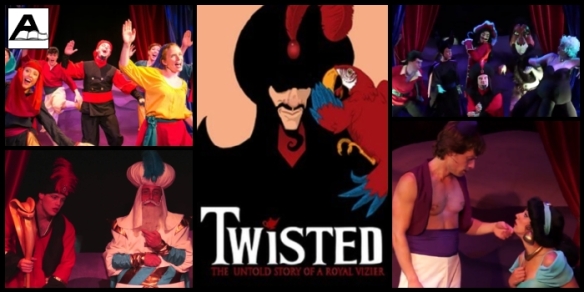
header071The hosts have their fair share of laughing fits while discussing the new Starkid musical Twisted, a retelling of Disney’s Aladdin… among other tales. With elements from Wicked, One Thousand and One Nights, and some real life Disney/Pixar happenings, this was the perfect story for Team Starkid to tell and might just be our favorite musical yet.

iTunesTwitterFacebookTumblrYouTubeDownload This Episode

For similar adaptations, check out our episodes on Frozen, Epic, Once Upon a Time, Snow White and The Lizzie Bennet Diaries.

Continue reading