In which Jenn presents fan responses for adaptations that were better than the book!
 Kendyl and Ryan sit down to watch The Terminator (1984) and discuss the weirdness of time travel and the rudeness of the person that decided to mow the lawn outside their window during our podcast.
In which Jess goes a little overboard in dream-casting not only Marissa Meyer’s Cinder, but her entire Lunar Chronicles series!
by Sarah J.
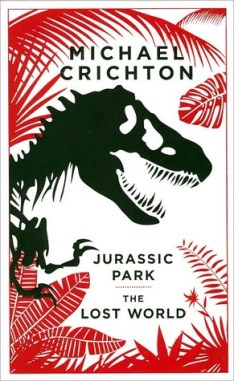
I fell in love with Jurassic Park the way most people of my generation did: sheer, abject horror intermingled with an intense curiosity and juvenile fascination with dinosaurs.
I first saw the film as a naïve five year old. My parents rented it on videotape from Blockbuster, the way we did things back then. I was not allowed to watch it at first, but after glimpsing the cover of the tape box and realizing that “holy bejebus, there’s dinosaurs in this movie!” I begged my mom to let me sit in. She thought it was going to be too scary; I thought it was going to be like a live-action version of The Land Before Time where people just got to ride around on dinosaurs. It didn’t take too long to figure out I was very wrong.
I don’t remember much from that first viewing. I remember crying uncontrollably in the first ten minutes or so, when a black guy got eaten by a velociraptor and the smarmy safari dude was unable to save him (turns out the guy wasn’t black, he was Costa Rican, but as a small child of mixed race heritage I just assumed every brown person was black, and also why do they always die first?). We had to pause the movie so my parents could calm me down, and after many reassurances that I was mature enough to handle it they let me keep watching. From that point on it’s all a fabulous blur. I know it was violent and probably not something a kid my age should have watched, but I was captivated.
 As I got older and eventually acquired and burned out my own tape of Jurassic Park, I realized that yes, the allure of dinosaurs was what had initially drawn me in, but what really kept me in was the science. I was ensconced by the reasoning behind it all. The high-tech facility, the people in lab coats rushing around creating these new animals, the DINO DNA! Even the (then very modern) look of the exotic resort was all a draw.
This is what captured my attention and fascination with the movie, but really made me stick around for the book. It wasn’t until my mid-twenties that I even got my hands on a copy, but once I picked it up it was nearly impossible for me to put down. For all intents and purposes the movie pretty much follows the novel: eccentric and ridiculously rich old man has way too much hubris, creates theme park, makes dinosaurs, invites team of specialists to inspect said park (and for some reason invites his useless grandkids to tag along), one specialist predicts doom, stuff starts to go wrong, roughly half of the people wind up dead, and we learn a valuable lesson along the way about playing God and also that birds are basically tiny dinosaurs in disguise. The end.
Where it greatly digressed from the plot of the original material was that one little detail I had wanted more of: science. The book spends a great deal of time setting you up to believe that the science used is a real possibility and it’s already happening; you don’t even get to that magnum opus T. rex stomping on cars scene until almost 200 pages in. Complex theories of math and science are cited numerous times, most notably by Dr. Ian Malcolm (portrayed by Jeff Goldblum in the film), who is described as being a genius with the personality of a rock star.
Pretty much every scene he’s involved in is just a way for him to explain some reason for why the entire park is going to blow up in everyone’s faces. He starts off by explaining the theory as basically as possible, then when people (usually the old rich dude, Hammond) fail to understand what he’s saying, he breaks it down with real world examples to slap some truth in their uncomprehending faces. To most people such a character could be described as pompous and conceded, but Malcolm’s redeeming quality is that he’s just always right, and he knows it, and that makes him bearable and, dare I say it, somewhat likeable.
(Also, in the film, he spends half the movie lounging around, wounded and sweaty, with an open shirt quoting scientific facts like its freaking Shakespeare. Be still, my heart.)
 My other favorite character to follow due to his sexy, sexy science brain is Dr. Alan Grant (portrayed in the film by Sam Neill). He’s a nerd in all the best ways, shown in the film as almost passing out in sheer joy at the sight of living dinosaurs. In the book he’s a bit more quiet and hands-on about his excitement, pretty much ignoring everyone when there’s a live specimen around to poke and prod at. My favorite scene of his is at the hatchery during the initial tour (another long section of the book filled with tons o’ science, and probably one of my favorite parts) where he sees a baby raptor in the nursery. Most of the others just pet it like a domesticated animal or ignore it completely, but Grant just picks that baby up and starts examining it like the greatest dang thing he’s ever found. He even flips it upside down to get a look at its nether regions, an act that scares the crap out of poor baby raptor and basically sends Dr. Wu (lead geneticist, portrayed by the smoldering B.D. Wong) into a barely controlled rage. Great work, Grant.
Side note: Dr. Grant is said to be a middle-aged dude with a beard wearing sandals, khaki shorts, and a Hawaiian print shirt. He’s pretty much your nerdy uncle that happens to be a paleontologist, if your nerdy uncle looked like Supernatural-era Jeffrey Dean Morgan going off on dino digs. Sorry, off topic, but these are the mental pictures I create while reading and it really does make everything that much more fantastic.
My last great player in this trio of fantastically scientific gents is Robert Muldoon (played by Bob Peck), the game warden of the park and aforementioned safari man that failed to save that poor worker from the raptor in the first ten minutes. Not only does he get the best lines in the film (“SHOOT HER!” “Clever girl.”) but his characterization is tweaked ever so slightly to make him more likeable on screen. In the movie he’s portrayed as a master of big game hunting ad an expert in animal behavior, and offers a lot of valuable insight into the hows and whys the dinos at J. Park are doing what they’re doing.
I wanted to like him as much in the book as I did in the movie, but I just couldn’t. Why? He’s a huge stinkin’ drunk and spends the last half of the novel sloshenly shooting a grenade launcher at a T. rex and playing chicken with raptors. Admittedly, that sounds pretty cool. But I’m definitely sure if he’d been about 100% more sober a few deaths could have been avoided. But you know, we all deal with the stresses of life in our own ways.
Extra side note: Bob Peck as Muldoon was spot on and I didn’t need to change a thing in my mind. Neither would I want to; him running around in those tiny safari shorts is a memory I will treasure forever.
The surprise player in the book was Donald Gennaro (unfortunately portrayed by Martin Ferrero). You may remember him as the slimy grease ball lawyer that died on the shitter during the T. rex attack scene. As soon as he was introduced I decided to develop a deep and determined disdain for him, but as the story unfolds Gennaro actually becomes one of the good guys. He’s basically the everyday man in this scenario. He knows nothing about science, animal husbandry and behavior, or theme park operations and is forced into this weekend trip where he’s asked to evaluate the safety and sensibility of all three of these major components. Even though he’s almost constantly be chased and almost eaten, Gennaro puts on a brave face and made it way further into this novel than most of the other Jurassic Park crew. It’s for this reason that I am claiming him the people’s hero of Jurassic Park, and the real casualty of the adaptation because let’s face it: we could replace Gennaro’s character with you or I, friend, and we probably wouldn’t have made it half as long.
 Overall, I give Jurassic Park the novel 10/10 stars. It doesn’t matter what draws you in. For me, it was the science aspect. For you, it could have been the action, or the adventure, or the early 1990s computer jargon I didn’t understand. Shoot, maybe you just really love dinosaurs. No matter who you are this book has something in it for you that’ll be worth taking away. If the success and enduring legacy of the film is any indication of the fascination we have with this story, then the book is sure to go down as a beloved classic.
Five year old me would be pleased with it. Traumatized and very confused, but pleased.
In which Kendyl lists the actors that did their best to shine, despite being in awful adaptations.
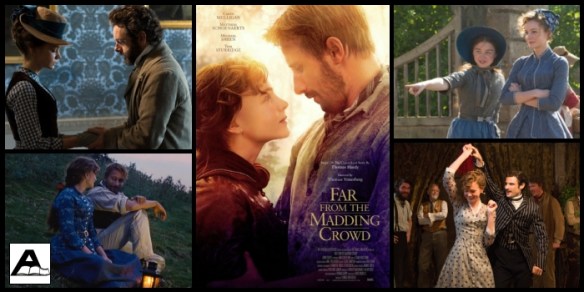 After loving Thomas Hardy’s novel as much as we did, it’s somewhat surprising that we ended up being really happy with Far from the Madding Crowd (2015). There were a few nick-picky things we would have done differently, but the film spurs additional understanding and conversations about the themes and characters that we loved and hated going in.
 The gang gets out some pretty intense rants about the storylines in Once Upon a Time season 4 in this episode. They admire the best character arcs, despair over the worst and make predictions about season 5.
 Despite the internet uproar, our hosts liked Age of Ultron overall. They wished some things had been set up better, but they discuss the character layers in depth and get excited about the future in this episode.
 The hosts could not be happier that Far from the Madding Crowd by Thomas Hardy made it onto our schedule. They enjoy getting back to their roots with some classic lit, and found FftMC a funny, progressive and thoroughly absorbing read.
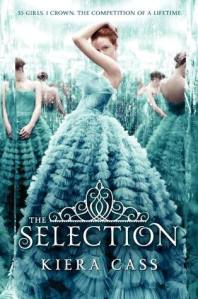 It is official, Kiera Cass’ series The Selection are becoming movies. After the CW lobbied to make a television series out of the soon to be quartet, Warner Bros has won the rights, according to Deadline Hollywood.
The Selection follows 35 under privileged girls who are chosen to compete for the hand of the crown Prince of Ilya. It is sort of like the Bachelor, but with a set in stone ending. The winner will become the Queen of Ilya and they must marry the prince. The story is centered on America Singer, a young girl who only entered the selection for the benefit of her family and at the request of the boy she is sweet on. The books follow her role in the selection and how she goes from young girl unsure of what she wants and what she stands for, to a young woman in the buddings of real love and a passion to make the world a better place.
I was actually pretty excited when I heard the news that they were going to be adapting it into a film instead of a TV series. I personally feel that the TV medium would not have been appropriate for this series. There is not enough meat to the books for it to stay true to the story line and characters.
What are your opinions? Do you think it would be a better TV series than movie? Any casting predictions or hopes? Leave us a comment below and be sure to look for reviews of the books and movies in later posts and podcasts.
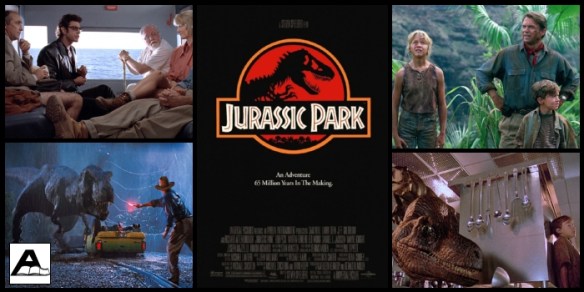 The hosts sit down and watch Jurassic Park, talking through the film about all the inferior security planning, the character development, and how it all differs from Crichton’s novel.
 Kendyl and Jenn discuss the film Home (2015), what is lost and found in the changes from Adam Rex’s novel and what aliens would really think about the weird stuff humans have invented.
Make sure you check out our episode on the novel!
The Last Unicorn was a favorite childhood film of mine; maybe not THE favorite, but in the top ten. I had watched it many times over the course of my childhood, but it wasn’t until just after I graduated high school that I finally picked up the book to read.
My mind was blown. The characters filled out, the world was round, there was rhyme and reason, and the end of the book was that much more tragic, and yet happy; true sorrow and true joy, and regret. Almost immediately I realized how much better the book was, and how silly it made the film seem.
Just over a year or so ago, I acquired the Blu-ray of the film. I still had fond memories of the film and besides that, Jeff Bridges is a voice. In fact it has a pretty great cast especially with Christopher Lee as the villain King Haggard, as well as Angela Lansbury, Alan Arkin, and Rene Auberjonois. I gave it a re-watch and suffice it to say, I actually remarked, “This movie is not as bad as I remember!” Still, it had been near 10 years since I read the book.
I took it upon myself recently to get a real picture of both of them in close proximity, and do a full and thorough comparison.
 Plot Comparison
The Last Unicorn is a 1982 animated fantasy film produced by Rankin/Bass for ITC Entertainment and animated by Topcraft. The film is based on the novel (published 1968) of the same name written by Peter S. Beagle, who also wrote the film’s screenplay. The Last Unicorn is about a unicorn who, upon learning that she is the last unicorn in the world, goes on a quest to find out what has happened to the others of her kind.
Both the book and the film take generally the same path. The unicorn hears that she is the last, and goes searching for more of her kind. Along the way she meets Schmendrick the magician who helps her and joins her quest. They get into some trouble with a band of rogues, but after they escape, Molly Grue-the only female from the group-decides to join them. They set off for the castle of King Haggard who has a bad reputation and a demonic red bull at his side. It is said that the red bull had chased all the Unicorns away long ago, so they know they will find some answers there.
The book, however, is so much more in-depth and sturdy up against the silly humor of the animation. I want to say that the book is more adult, but the situations themselves would not call for an adult rating.
The main problem with the film is that Rankin/Bass made it into a family movie, which means that much of the story is watered down and it glosses over the points where the book is dark, gritty and bloody. Even when the dialogue makes reference to an injury, the audience sees no blood. The one exception to the non-adult rule is the harpy, Celeano. I never noticed before this, but the harpy has exposed teats which was a bit shocking considering. Although I dislike the design of the creature, it is pretty frightening. I just really wish that the harpy looked like a harpy and not a weird type of carrion bird. In the book the harpy is described as having the face of a hag with hair like moonlight and wings of bronze.
Rankin/Bass is also known for throwing in a random song (most performed by America) to emit emotion while trying to create a montage that tells us something that otherwise would have been missed, but somehow we still miss it. At the beginning when the Unicorn is supposed to have traveled for a very long time before meeting any of the characters, the film took the time to show the changing seasons-maybe a bit too much time. Then later when they are supposed to have been at Haggard’s castle for a long time, you don’t feel like it has been more than a few days. They show a montage of Prince Lir fighting dragons and bringing Lady Amalthea the head as a prize, but they miss that he was not a hero-type before he met her, nor does it mention that he was engaged before-hand. It shows that she cares little for the dead presents he brings, but it misses how it hurts her to find his horse was injured in one of his battles.
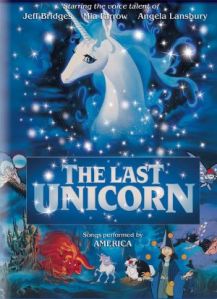
We also lose many of the great characters from the book in the film–Drinn and all of Hagsgate, Haggard’s soldiers-at-arms and the mayor of an indulgent town–who is supposed to be the reason they meet the band of rogues. And the characters we do have aren’t given the background they need or are unnecessarily changed.
The butterfly is not changed that much, but considering the watering down of the story and characters, I don’t understand why they choose to make the butterfly talk so much–including saying that Man cannot see the unicorn, but mistakes it for a white mare. This is untrue! People with pure hearts can always see a unicorn as well as many others, just less so now that unicorns seem to have left the world. The fact that man sees a mare instead is shown just a scene later, so why waste your time and breath, butterfly?
An even worse change was to the cat. In the book, a cat appears in the kitchen of Haggard’s castle and Molly takes a liking to it. When the time comes, the cat chooses to speak-to Molly’s surprise-and she heeds his words even if they are a bit of a riddle. Once everything is said and done, the cat stays with Molly on her next journey. In the film, they decided to give the cat a peg leg and an eye patch and turn it into a pirate. For no good reason. And when the castle falls, what happens to the cat? Guess it died.
Captain Cully, the leader of the rogues becomes a non-character, only there so we can meet Molly Grue. She is still wonderfully brash in the film, but she loses all of her best retorts and relationship/character building moments, so when Schmendrick says “Come with me” and she replies “I will”, it just seems out of the blue and a little stupid.
Meanwhile, Schmendrick just seems like a bumbling idiot who really wants to be a magician, but hasn’t found his way to true magic yet. Some of the spells that he conjures in the film don’t seem to have a reason behind them, while in the book they are well explained. All through the film he says “Magic do what you will” repeatedly, but we don’t really know why. As a child, I know I made a conscious leap from there to know that he was just a conduit for magic and didn’t know how to control it, which is true in the original story, but he has a more fleshed out background. You know who he is and what he has been through and see him trying many tricks and spells throughout the book that show that he can do parlor magic and he has trained to be a true wizard but has yet to fully succeed.
Although the cast is generally good, I feel like much of the voice acting is lack-luster. Christopher Lee, Jeff Bridges and Angela Lansbury are fantastic. Hell, I’ll throw Tammy Grimes (Molly Grue) in there too. Alan Arkin (Schmendrick) and Mia Farrow (Unicorn/Lady Amalthea), however, not so much, though I think it’s partly the way they are portrayed in the film.
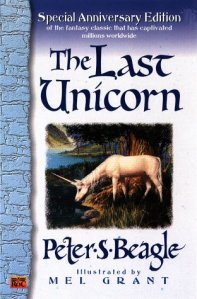 I know that Peter S. Beagle wrote the screenplay, but I wonder how much influence the director and producers had, because there were character changes that I am not okay with, like when the Unicorn feels pity for the Harpy. That is not how it is, the only reason she wants the harpy to be free is because if Mommy Fortuna frees her soon, she might just survive it–the pity is all for the poor old witch. Mia Farrow is just obnoxious in general, she puts inflections in her lines that rub me the wrong way and are not at all how I imagined my unicorn. Then they give her songs to sing–really cheesy songs that I loved as a kid–and she can’t really sing. But apparently if you get the German soundtrack, they replace Mia Farrow with a better singer and it sounds great.
There are songs in the book, but they are much less cheesy, and sometimes even dark. She asks Prince Lir to sing her a song to drown out her nightmares, and he sings the first thing that comes to mind, which happens to be a not-so appropriate song. But I love that it was not a love song to her, but more an epic of tragic love and betrayal. The weird thing is that there are moments in the story where I think they give the unicorn more magic than she had in the book, and yet Mia Farrow and her lines make her sound like she has no power at all. How can she be that powerful and that powerless at the same time?
It’s not that she’s all-powerful in the book—she has restrictions—and yes there are times where she has inexplicable power, but it isn’t jarring or confusing. When Lady Amalthea trips while being chased by the red bull, in the book she doesn’t whine and say “oh my ankle, help me!” Magic made her a mortal woman, but that doesn’t mean they can take away her character’s stength. It’s sexist. She is supposed to be confused and forget why she is where she is, but she doesn’t lose her fight and suddenly need the prince to save her like a damsel in distress.
In addtion, some of the side characters are lost, and without them we never learn of the curse put on Haggard’s Castle or Hagsgate and what that meant for the people. The world outside of the quest is a flat one in the film. Besides the few smatterings of characters, we don’t know what the world is like, and since the Unicorn has traveled out of her forest and into the world of man for the first time in so long, you would hope to see more of it.
The animation leaves something to be desired as well. Usually I would say that animation can do things that many live-action films cannot, but in this case I think live-action would prove wiser. The characters move in such inhuman ways, and when Schmendrick falls after letting the magic take its course with him, he floats to the ground in what I would guess is a faint, but it looks so odd. There are points where characters are supposed to be thrown, thrashed and crushed and none of it looks right, they all float and fall so gently. One character has to tell us that he was dead after he is revived because otherwise we wouldn’t have known (he does say it in the book as well, but in the book he is a tangled mess and you knew he wasn’t going to walk away from that).
Haggard’s castle is also completely ridiculous. It is supposed to be worn down, standing only by sheer will. It’s very dark and there is a skull hanging in the hall, but beyond that it was a regular castle. In the film, to really drive the point home that Haggard is evil, the castle is full of demonic statues and dragons and horns. It is so far over the top and one wonders why Prince Lir–being the opposite of his father–would even continue living in a place like that. Being run down is one thing, but to be complacent with the awful interior design of this castle… I don’t even think a hag of a witch would build a place like that, and she was supposed to have. When you really get to know Haggard, at least in the book, you find that he is less evil and more just a miserly, bored, and unhappy old man who has never found joy, except one, and I don’t mean his son.
 The character design for the Unicorn and Lady Amalthea, however, are quite beautiful. She glows and is graceful in both forms. They got the Unicorn right, with the tail of a lion, cloven hooves, and hairy ankles, rather than a white mare with a horn. My only gripe about it is that as a Unicorn she is supposed to be a much larger creature than she is in the film. In the book, Schmendrick remarks about it when he finally sees her up close. Also, in the normal world, men see her as a white mare, which is fair enough because magic has left most of the normal world, but when we see her through the eyes of a farmer, she looks like herself (lion tail and all) just without a horn. What white mare looks like that?!
In the end I would say that it is a fun film if you have had some distance from the book. It has its charms and is a cult classic that still shows all over the country. Still, to me, the film is more of a trailer to the book than an actual film in itself, if trailers ran 93 minutes. I don’t mean to tear it down—though I feel like I just have—because it could have been worse. At least they didn’t change the ending to a wedding or something. That would have been too sappy. It’s cute, but it just doesn’t do the book justice.
That is why I still wish for the live-action version that was talked about in the early 2000s. The website for it still exists, so that means there’s still hope, right? I even did a dream cast vlog for the film last week!
As for now, please go read The Last Unicorn by Peter S. Beagle. It is a fantastic book. And of course, feel free to see the 1982 Rankin/Bass Animation, but remember to take it with a grain of salt. This one is up there with the animated versions of The Hobbit, Lord of the Rings, and The Black Cauldron. This was my earliest experience of “the book was better” and it is, to the greatest extent.
 After our episode chalk-full of different versions of Cinderella, the hosts are slightly disappointed that the new live-action Disney version is twist-less. On the other-hand, they can’t deny that is was a gorgeous film, that it answered some questions they’d been asking and that Helena Bonham Carter can do no wrong.
 Adaptation Podcast